Control glare at the optics
The filter helps reduce distracting reflections from regular glasses and sunglasses before they obscure detail in the captured image.
 Trucking
DMS + DSC / Ready for the road
Preparing the 3D experience for your visit. Videos load when you choose to watch them.
You’ll enter automatically as soon as the 3D models are ready. Videos won’t delay your visit.
TruckingDriver monitoring system · C29N
Dedicated attention to the driver. A wider understanding of the cabin. Meet Streamax DMS + DSC.
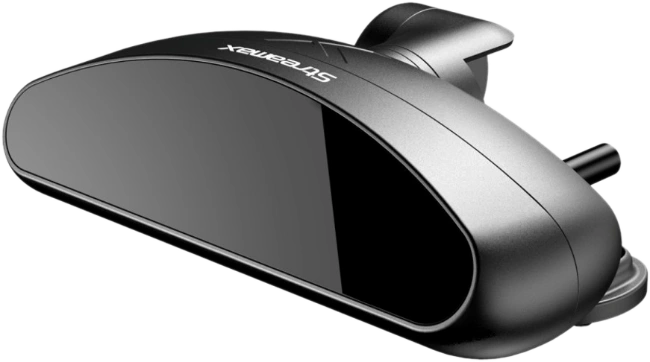
Explore the product and videos below.
C29N sits on the driver’s A-pillar, with the dashcam mounted on the windshield.
Illustrative installation. C29N housing is a visual representation; select the correct mounting variant for each vehicle.
Focused on the moments
that matter.
Penetrating sunglasses
Infrared imaging helps reveal eye detail behind compatible sunglasses, so dark lenses do not always hide the signs of fatigue.
Visible light: dark lenses can obscure the eyes.
Illustration · compatible sunglasses · choose either view01 / Infrared imaging through sunglasses
DMS uses infrared imaging to see eye detail through compatible sunglasses. This is a property of infrared transmission through the lenses, separate from the glare-reduction filter.
Lens material and coatings matter. Infrared-blocking sunglasses can still obscure the eyes and limit fatigue detection.
Watch glasses & reflections ↗Reducing glares
Streamax’s patented optical filter helps control reflections on glasses while preserving the driver detail needed for monitoring.
02 / Glare reduction Patented by Streamax
Streamax’s patented optical filter is designed to control unwanted glare in the camera’s optical path while retaining a useful infrared image of the driver.
The goal is more than reducing reflections: it is preserving the contrast needed to read eyes, facial movement and safety details as sunlight and cabin conditions change.
The filter helps reduce distracting reflections from regular glasses and sunglasses before they obscure detail in the captured image.
Glare control is balanced with image visibility, helping preserve tonal separation across the eyes, face, clothing and seatbelt.
Better visibility of eyelids, facial movement and belt position supports driver-state analysis and makes recorded events easier to review.

03 / Compare the infrared views
The same installed C29N viewpoint in every feed. Compare head tilt, eye closure, sleeping, seatbelt use and drinking, with illustrative AI boxes and alert outcomes.
The 3D comparison could not load.
Illustrative AI comparisonAmber dashed box: missed alertRed box: alertGreen box: no active alert
The preset demonstrates missed eye-closure and sleeping alerts with Regular DMS, a false seatbelt alert with reflector film after buckling, a bottle mistaken for a phone in the dark reflector-film view, and correct detection and clearing in all shown Streamax scenarios. These are scripted examples, not measured accuracy or a detection guarantee. All three views use the same camera position, viewing direction and field of view as C29N Infrared in Animated Installation. They are black-and-white illustrations of the same 3D scene. The film view deliberately illustrates lost shadow detail: the dark belt and clothing become almost indistinguishable. This is a demonstration effect, not a measured film result.
Compare the three approaches
Compare reduced reflections, overall brightness and the details needed for driver monitoring.
Streamax’s patented optical filter controls distracting reflections while helping keep the driver’s features visible.
Reduces polarized reflections, but also removes about half of unpolarized incident light in the ideal case.
*The 50% figure describes an ideal linear polarizer with unpolarized light; real film transmission varies. It is not a measured C29N-versus-film result. A well-matched polarizer can improve clarity where reflections dominate.
The animation illustrates image-quality tradeoffs. Exposure, reflection and fabric-contrast settings are demonstration effects, not measured product performance or detection guarantees. Results depend on installation, lens coatings and lighting.
The reflector-film light-loss explanation refers to an ideal polarizing film. See polarization and light transmission. Sunglasses and reflection footage comes from the supplied C29N launch presentation.
The Streamax advantage
A dedicated view of the driver’s upper body and a wide view of the entire cabin solve different problems. Streamax brings them together.
C29N frames the driver’s face and upper body, preserving the facial detail needed to monitor eye closure, gaze, head position and fatigue.
 Face + upper-body coverage · 3D illustration
Close, carefully positioned optics support detailed driver-state monitoring.
DMS + DSC
Keep the driver detail. Add a second angle across the whole cabin.
Explore the difference ↓The dashcam’s inward-facing Driver Status Camera covers the entire cabin, including the driver, passenger seat and surrounding interior, for behavior detection and event review.
 Entire cabin coverage · illustration
A complementary angle can reveal what a steering wheel or a close crop hides.
Watch the warning while the belt is unbuckled, then follow the driver fastening it.
The scenario explanations remain available above.
A wider cabin view adds a second angle around the steering wheel.
Drag to explore · cabin cutawayCamera rays are calculated from lens position, viewing angle and the first cabin surface or cabin boundary they meet. The C29N image uses illustrative infrared tones to separate dark fabrics and seatbelt straps. The chosen lens angles and AI overlays illustrate the events; they are not measured product calibration or live AI detections.
DMS + DSC seatbelt integration is documented for AD Plus 2.0. Confirm support for the selected hardware and firmware.
Facial base by Face Cap, provided to the three.js project (MIT license). Skin reference: “Infinite, 3D Head Scan” by Lee Perry-Smith / Triplegangers, CC BY 3.0. Adapted geometry, skin projection, hair, materials and animation for this illustration.
Hands: WebXR Input Profiles, the hand mesh used by Three.js XRHandMeshModel (MIT license). Adapted surface smoothing, skin materials, driver fitting and object grips.
| What you need to see | Dedicated DMS | DSC | DMS + DSC |
|---|---|---|---|
| Eyes and facial detail | Facial detail within the upper-body view | Wider view, smaller face | Preserves dedicated facial detail |
| Upper body and hands | Driver’s upper-body view | Cabin-wide view of driver and passengers | Complementary viewing angles |
| Seatbelt hidden by the wheel | Can be obstructed | Alternative line of sight | Helps resolve occlusion cases* |
| Eating and drinking behavior | Facial attention and driver state | Hands, food and drink containers | Behavior context alongside facial detail |
| Reviewing a flagged event | Driver-state evidence | Behavior and cabin context | A more complete account |
*Supported integration required. Visibility, installation, lighting and algorithm version affect detection. Two cameras do not eliminate every blind spot.
DSC + extended sensing
Pair C29N’s face and upper-body view with cabin AI that recognizes behaviors, body movement and the people on board.
Identify food and drink interactions through visible hands, objects and the mouth. Add the action behind a moment of distraction.
Complement the dedicated driver view with DSC fatigue analysis and examples of eye rubbing and fatigue-related body posture.
Extend the cabin view to passenger seatbelt detection and occupancy counting for a fuller picture of the journey.
Capabilities shown in the DMS presentation, slide 4. Availability depends on the selected camera, recorder, algorithm and firmware. Validate the intended functions in your vehicle configuration.
Recorded demonstrations
Explore the original presentation footage: C29N imaging, eating and drinking detection, fatigue cues and wider cabin awareness.
Adapting to the driver
See C29N imaging as the driver changes posture.
Video could not load.
C29N launch presentation · 2022. Illustrative face highlights added for presentation. Extracted from the supplied Streamax presentations. Recorded examples, not a live feed or a guarantee of performance.
Flexible mounting.
A purposeful viewpoint.
Designed for the face
Face-region exposure control helps preserve useful detail under side lighting, dark clothing and reflective workwear.
Intelligent infrared illumination and face-centered exposure help the camera preserve facial detail as lighting conditions change.
The IPC DMS approach combines a learned fatigue probability with accumulated eye closure, rather than relying on one eye-closure rule alone.
C29N supports dashboard, A-pillar and windshield installation variants. Match the product code to the mounting location. The launch material specifies a 50–100 cm driver distance; validate the full face and belt view in the actual cab.
Infrared-blocking glasses can compromise fatigue detection. Covered eyes or mouth, gloves, glare and occlusions can also limit individual functions. Check the chosen camera, firmware and installation before rollout.
Set up for your operation
Good deployment combines camera positioning, appropriate alert settings and regular review with the drivers who use it.
Sustained driving and night work put fatigue at the center of the risk profile.
Suggested tuning directions from the parameter guide, not settings applied to a vehicle. Start a new deployment at Medium, validate in service, then adjust to route and driver needs. Mirror checks and intentional maneuvers must be considered.
Record alerts and review the driver’s actual state.
Address false alerts and missed detections.
Fine-tune for each route and driver.
Make regular event review part of fleet operations.